Comics maven Jim Shooter has passed away at the age of 73.
It’s hard to overstate the importance of Mr. Shooter to (mostly) superhero comics, especially at Marvel. Although he sold his first stories, to DC for Legion of Superheroes (a book he remained associated with) at the ripe old age of 14, Mr. Shooter is mostly, and legitimately, remembered for his run as Editor in Chief at Marvel during one of the most successful stretches in the company’s history.
Shooter was not a beloved figure to many of his contemporaries, to say the least. The ‘creatives’ resented being reigned in by Shooter, who had strict ideas about how Marvel books should be written. Many of his instincts were undoubtedly correct. For the seminal Dark Phoenix Saga, writer Chris Claremont had intended to let Jean Gray live, the idea being that she wasn’t really responsible for the actions of her cosmic alter ego the Phoenix. Shooter was having none of it. The Phoenix at one point was shown destroying a planet, extinguishing the lives of billions of sentient beings. Shooter demaned that Gray had to pay the ultimate (if temporary) price for these deprevations. And he was right. That tragic ending was exactly how the story needed to end. The Saga would surely not be quite as well remembed today if Claremont’s watered down ending had prevailed.
The tension between suits and creators is an old story, but again, Shooter was also himself a veteran writer and thus not just some BA holder with no comics background who was brought in to make Marvel more of a regular business. There was a lot of that, though. Under Roy Thomas’s prior run as Editor in Chief, the creatives were basically allowed to get away with murder. Shooter was having none of that nonsense. He ran a tight ship and many creatives hated him for it.
Now, I’m sure some had legitimate beefs with Shooter, who was the boss and knew it. However, it should also be noted that the writers and artists of the time were prone to constant and suprisingly bitter feuds with their fellows. Imagine the faculty of a small liberal arts college where, to quote Wallace Stanley Sayre, “”In any dispute the intensity of feeling is inversely proportional to the value of the issues at stake….That is why academic politics are so bitter.” Academic politics, and comic book politics as well.
Here’s one example of Shooter’s being not at fault for any bad feelings he engendered:
“My favorite Jim Shooter story, and one that arguably changed the fortunes of Hasbro as a toy company, was Shooter getting the rights to G.I. Joe, and finding out that their initial run sold out because it had a lower printing than average because his head of sales Michael Friedrich didn’t like military books, encouraging stores to instead buy Elric, a [graphic novel] he wrote.*
Shooter IMMEDIATELY fired Friedrich when he found out and ordered a second printing of Joe, which went out to outsell X-Men in subscriptions (and this was X-Men at the height of Chris Claremont’s creative powers) and pave the way for more licensed comics, including Transformers. So Shooter opened the door for two massive franchises because sales mattered more than Friedrich’s feelings.“
*Shooter pioneered the idea of graphic novels in America. The such was The Death of Captain Marvel. The second volume was Friedrich’s Elric.
Again, I’m sure some of the people who hated Shooter had good reasons to do so. However, I think there were a lot more people like Firedrich who just didn’t want to have to, you know, be all corporate and stuff.
I had the good fortune to meet Mr. Shooter at an early Comic-Con in Rosemont IL in the (I believe) early ‘80s, when I was in high school. Mr. Shooter held a packed and extremely fun and informative Q&A session, aswering all questions tossed his way while also asking for feedback from some of the company’s most fervid readers. When the Q&A ended, Mr Shooter repaired out to the atrium and spent a good long while talking to anyone interested enough to come by. A towering 6’ 7”, and wearing a most un-Comic-Con starched white button up shirt and tie, he was easily recognized by anyone likely to be attending such a Con. Having such intimate access to someone of his level on such a casual basis was pretty stunning.
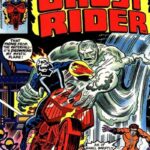
As a writer Mr. Shooter had a brief stint as writer on Ghost Rider, the original Johnny Blaze run. This was during my favorite period of the character, where he was morphing into more of a superhero (albeit a pretty strange one) in his own book and as a member of the ill-fated Champions. Eventually asshole and renowned incompetent mystic Dr. Druid, in the issue pictured above, assumed Johnny was a demon with pretty much no research and blew up his life. Learning only after downing him with a sucker punch—after the Ghost Rider declined killing the arrogant prick who had just destroyed the only stable period of his life since making a deal with the Devil—Druid finally bothered to learn that, uh, oh, Johnny was actually a good soul. “I learned a bitter lesson today,” he said (because this was all about him), and left Johnny to become an aimless wanderer as the book again assumed more of a horror theme.
I’d say my favorite storyline of Mr. Shooter’s was the Korvac Saga, a multi-book affair that run over a year, starting with a mystery of disappearing superheroes and ending with a fight against a cosmic foe so powerful that one of the Avenger’s most powerful line-up, along with that of the pre-Starlord Guardians of the Galaxy, ended up being slaughtered. This is old hat nowadays, but this was the first such epic and longform storyline, and I can tell you it was strong meat at the time. Featuring of the Avenger’s most iconic line-ups, and with (mostly) art by George Perez, the only man to rival John Byrne at the time, it remains one of my very favorite comic storylines ever.
Comics could sure use a Jim Shooter these days. Rest in peace, sir. You will not be forgotten.